 Ultimate guide
The Beginner's Guide to Safe Driving for New Drivers
Last Updated: October 25, 2026
Quick Summary
Safe driving tips new drivers need form the foundation of becoming a capable, confident road user. The core principles include developing situational awareness, understanding vehicle control, and learning to anticipate hazards before they become emergencies.
- Look 12 to 15 seconds ahead to spot potential problems early enough to respond smoothly.
- Use the two-second rule for following distance; increase to three or four seconds in wet conditions.
- Adjust speed downward when conditions warrant, as posted limits are maximums, not targets.
- Structure practice around one or two specific fundamentals per session rather than trying to improve everything at once.
- Complete basic pre-drive checks including seat position, mirror adjustment, tyre condition, and light function.
Table of Contents
- Safe Driving Tips for New Drivers: Building Confidence and Awareness
- Master Defensive Driving Tips for Beginners
- How to Get Better at Driving: Practising the Fundamentals
- New Driver Mistakes to Avoid on the Road
- Driving in Hilly Terrain: Tips for Challenging Roads
- Vehicle Setup and Pre-Drive Checks for Safety
- Your First Solo Drive: Building Independence Safely
- Frequently Asked Questions
Safe Driving Tips for New Drivers: Building Confidence and Awareness
Safe driving tips new drivers need form the foundation of becoming a capable, confident road user. Whether you're a teenager preparing for your first solo drive or an adult returning to driving after years away, understanding the core principles of safe driving can mean the difference between a smooth journey and a dangerous one.
At Precision School of Driving, we work with learners who feel anxious about taking control of a vehicle. Many of our students arrive with over 100 hours of supervised driving behind them but still feel unprepared for independence. The issue isn't usually a lack of practice, it's a lack of structured confidence-building and real-world problem-solving skills.
Safe driving isn't just about following rules. It's about developing situational awareness, understanding vehicle control, and learning to anticipate hazards before they become emergencies. This guide covers the essential safe driving tips new drivers need to build genuine competence and independence on the road.
Master Defensive Driving Tips for Beginners
Defensive driving is the practice of anticipating hazards and positioning yourself to avoid them before they occur. It's the single most important shift in mindset for new drivers moving from supervised practice to independent driving.
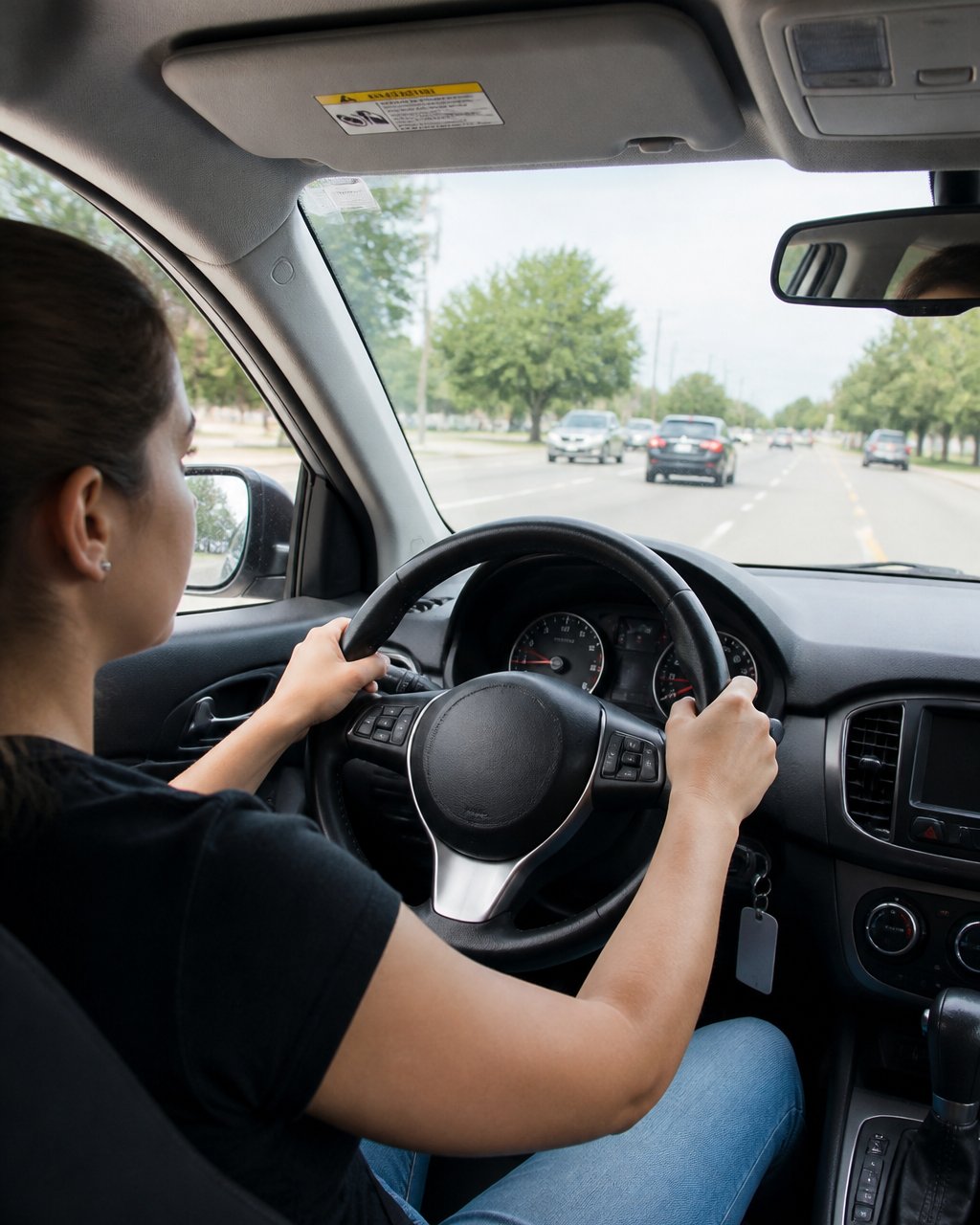
The core of defensive driving rests on three principles: scanning the road ahead, maintaining safe following distance, and adjusting your speed to conditions. Most new drivers focus only on the vehicle directly in front of them. Experienced drivers look 12 to 15 seconds ahead, roughly the distance you'll travel in that time. This means spotting potential problems early enough to respond smoothly rather than react in panic.
Following distance is where theory meets reality.
Speed control deserves its own emphasis. The posted speed limit is a maximum, not a target. New drivers often drive at the limit regardless of conditions, rain, fog, heavy traffic, or unfamiliar roads.
Watch out: many new drivers believe they can recover from a mistake through quick reflexes. Reaction time, even for alert drivers, is typically 0.75 to 1 second.
Road Safety Commission guidance on hazard perception emphasises that new drivers must actively train their eyes and mind to spot dangers early. This isn't instinctive, it's a learned skill that develops through structured practice and feedback.
How to Get Better at Driving: Practising the Fundamentals
Getting better at driving means repeating the same core skills until they become automatic, freeing your mental energy for hazard scanning and decision-making. Most learners plateau because they stop deliberately practising specific techniques and start simply accumulating hours.
Structure your practice around these fundamentals:
- Vehicle control: Smooth steering inputs, progressive braking, and consistent acceleration. Practice in quiet residential areas where mistakes have minimal consequences.
- Lane positioning: Staying centred in your lane, especially on curves. Many new drivers drift toward the edge or centre line without noticing.
- Intersection management: Approaching at appropriate speed, scanning for conflicting traffic, and positioning for your intended turn.
- Road scanning: Deliberately looking ahead, to the sides, and in your mirrors in a continuous cycle. Novice drivers often develop "tunnel vision," focusing only on the road immediately ahead.
- Speed adjustment: Slowing before hazards (pedestrian crossings, residential areas, poor visibility) rather than maintaining a constant speed.
Each practice session should focus on one or two of these areas rather than trying to improve everything at once. A 45-minute session spent deliberately practising smooth braking and lane positioning will improve your skills far more than two hours of casual driving.
Precision School of Driving structures lessons around this principle: rather than simply driving to a destination, we break each lesson into focused skill-building blocks. A learner who struggles with confidence benefits from targeted practice on specific road types or manoeuvres, with immediate feedback and explanation.
New Driver Mistakes to Avoid on the Road
Understanding common pitfalls helps you recognise and correct them before they become dangerous habits. The mistakes new drivers make fall into predictable patterns.
Underestimating speed and distance: New drivers frequently misjudge how quickly they're approaching hazards and how far they need to stop. This leads to late braking and close calls.
Overconfidence after a few good drives: A week of smooth driving can create false confidence. Then a unexpected situation, sudden rain, heavy traffic, an unfamiliar road, triggers panic.
Ignoring distractions: Mobile phones, passengers, adjusting controls, or eating while driving all reduce your ability to scan and respond to hazards. New drivers have the least mental capacity to spare.
Driving while fatigued or impaired: Many new drivers underestimate how fatigue affects reaction time and judgment.
Peer pressure and risk-taking: Passengers, especially friends, can influence new drivers to exceed safe speeds, take unnecessary risks, or engage in distracting behaviour.
Failing to adapt to weather and road conditions: Wet roads, fog, and darkness all require slower speeds and greater following distances.
Watch out: the first few months of independent driving carry the highest crash risk for new drivers.
Driving in Hilly Terrain: Tips for Challenging Roads
Hilly terrain presents unique challenges for new drivers. Gravity, sight lines, and braking dynamics all change on slopes, and many learners have practised primarily on flat roads.
Downhill driving requires special attention. Gravity accelerates your vehicle, making it harder to control speed. Brake early and lightly rather than braking hard partway down. Using lower gears provides engine braking, which helps control descent without overheating your brakes.
Uphill driving tests your vehicle's power and your ability to manage momentum. Approach hills with adequate speed so you don't lose momentum halfway up.
Sight lines on hills are dramatically reduced. You cannot see oncoming traffic until vehicles crest the hill. Never overtake on a hill unless you have absolutely clear visibility of the road ahead.
Cornering on slopes is more demanding than on flat roads. Gravity pulls your vehicle toward the outside of the curve, requiring more steering input and smoother inputs to avoid losing traction.
Australian Road Rules guidance on driving in mountainous regions specifies that drivers must adjust speed to maintain control in all conditions, including steep grades and limited visibility.
Vehicle Setup and Pre-Drive Checks for Safety
Before every drive, spend two minutes completing basic safety checks. These checks prevent mechanical failures and ensure your vehicle is set up for safe operation.
Seat and mirror adjustment: Position your seat so you can reach the pedals fully with a slight bend in your knee.
Steering wheel and pedal reach: Ensure you can operate all controls comfortably without stretching or straining. Uncomfortable positioning leads to fatigue and reduced control.
Seatbelt function: Check that belts fasten smoothly and hold firmly. Seatbelts are your primary protection in a crash, they must be worn by every occupant on every journey.
Tyre condition and pressure: Check that tyres are properly inflated (consult the driver's door jamb for correct pressures) and have adequate tread.
Lights and wipers: Confirm that headlights, brake lights, and turn signals function. Test wipers and ensure washer fluid is adequate.
Pedal function: Press the brake pedal firmly, it should feel firm and responsive, not soft or spongy. Check that the accelerator returns smoothly when released.
These checks take less than two minutes and can prevent accidents caused by mechanical failure or poor visibility.
Your First Solo Drive: Building Independence Safely
Your first solo drive is a milestone, but it's also when you're most vulnerable.
Choose your route carefully. Your first solo drive should be on roads you've practised extensively with an instructor.
Tell someone where you're going and when you expect to return. This isn't about permission, it's about safety.
Expect to feel nervous. Nervousness is normal and actually helpful, it keeps you alert and cautious.
Drive slightly slower than you would with an instructor present. You have no backup, so your margin for error is zero.
Manage distractions ruthlessly. Your phone stays in your bag or boot, not on the seat. Passengers wait until you're confident enough to manage conversation while driving.
After your first solo drive, debrief with your instructor or a trusted driver. Discuss what went well, what felt challenging, and what you'd do differently.
Graduated licensing requirements for new drivers set restrictions on solo driving hours and conditions for learners transitioning to provisional licences.
Consider customised driving lessons for beginners that focus specifically on building independence.
Building genuine safe driving skills takes time.
Transport Safety Commission advice for new drivers reinforces that building confidence and safety awareness is an ongoing process. If you're struggling with anxiety about driving, how to choose a supportive driving school can connect you with instructors who specialise in building genuine confidence rather than just test-passing skills. Build driving confidence through structured guidance that addresses your specific concerns and learning style.
| Driving Skill | Why It Matters | How to Practice |
|---|---|---|
| Hazard scanning | Spotting dangers before they become emergencies | Look 12-15 seconds ahead; scan mirrors every 5-10 seconds |
| Following distance | Ensuring you have time to stop safely | Use two-second rule; increase to 3-4 seconds in poor conditions |
| Speed adjustment | Maintaining control in varying conditions | Slow before hazards; reduce speed in wet, foggy, or hilly terrain |
| Vehicle control | Smooth, predictable handling | Practice on quiet roads; focus on one skill per session |
| Distraction management | Keeping mental resources available for hazards | Remove phone; establish passenger rules before driving |
Frequently Asked Questions
What are the most important safe driving tips for new drivers?
Safe driving tips for new drivers centre on awareness, speed control, and following distance. Maintain a two-second gap from the vehicle ahead, adjust your speed to road and weather conditions, scan the road constantly, keep both hands on the wheel, avoid distractions like mobile phones, and never drive when tired or impaired. These fundamentals protect you and others on the road.
How can new drivers build confidence behind the wheel?
Build confidence through structured practice in varied conditions: start in quiet residential areas, progress to busier roads, then highways. Practise the same routes repeatedly to develop familiarity. Take defensive driving courses to learn hazard perception. Reflect on each drive, what went well, what felt challenging. Professional instruction from patient instructors who support anxious drivers accelerates confidence growth significantly.
What are the most common mistakes new drivers make?
New driver mistakes include misjudging following distance, driving too fast for conditions, failing to check mirrors and blind spots, using mobile phones, panicking in unexpected situations, and not adjusting to weather or road changes. Many also neglect pre-drive vehicle checks or drive when fatigued. Awareness of these pitfalls helps you consciously avoid them through deliberate practice and reflection.
How can I prepare for a driving test in hilly terrain?
Hilly terrain requires specific skills: practise smooth acceleration and braking on slopes to avoid rolling back, master hill starts on gentle then steeper inclines, and learn to control speed going downhill using lower gears. Practise in the actual test area if possible, focusing on gear selection, engine braking, and maintaining safe speed. Understand how your vehicle handles weight transfer on slopes and practise until these skills feel automatic.
What should I do after a near miss or breakdown?
After a near miss, pull over safely, take deep breaths, and reflect on what happened and how to prevent it next time. After a breakdown, turn on hazard lights, move to a safe location away from traffic, and call roadside assistance. Never stay in the vehicle on a busy road. Document the situation and report any safety hazards to authorities. These experiences are learning opportunities, discuss them with your instructor to strengthen your skills.
How do I handle peer pressure when driving with passengers?
Set clear boundaries before passengers enter your vehicle. Explain that you need to concentrate and that safety is non-negotiable. If passengers distract you or pressure you to speed or take risks, politely but firmly refuse. Your provisional licence may restrict the number of passengers you can carry, know and follow these rules. Remember: your safety and that of your passengers depends on your decisions behind the wheel, not on pleasing others.