 How-to
How to Overcome Driving Anxiety: A Step-by-Step Plan
Table of Contents
- Why Driving Anxiety Happens (And Why It's Not a Flaw)
- How to Calm Anxiety While Driving: In-the-Moment Coping Strategies
- Driving Anxiety Exercises You Can Practise Before You Start the Car
- Gradual Exposure for Driving Anxiety: A Measurable Step-by-Step Plan
- What to Do During a Panic Episode Behind the Wheel
- Driving lessons for nervous drivers: What Good Instruction Looks Like
- Tracking Progress, Handling Setbacks and Knowing When to Seek Professional Help
- Frequently Asked Questions
Last Updated: October 17, 2026
Why Driving Anxiety Happens (And Why It's Not a Flaw)
Driving anxiety is a fear response that shows up before or during driving, and it is one of the most common barriers learner drivers face.
The fear usually has a trigger. A near miss, a stalled car at a busy intersection, a critical comment from a past instructor, or simply the weight of everyone watching.
That is why willpower alone rarely fixes it. You need a plan, not a pep talk.
The good news? Anxiety responds well to structured practice. Below, we break down exactly how to overcome driving anxiety with a plan you can start this week.
How to Calm Anxiety While Driving: In-the-Moment Coping Strategies
The fastest way to calm anxiety while driving is to slow your breathing and narrow your focus. Anxiety feeds on a racing mind, so give your brain one small task at a time.
Try these in the driver's seat:
- Box breathing: breathe in for four, hold for four, out for four, hold for four.
- Name what you see: "red car, stop sign, pedestrian." This pulls you out of your head.
- Loosen your grip: relaxed hands send a calm signal back to your brain.
The trick is to have these ready before you need them. A coping strategy you remember in a panic is worth ten you read once.
A Pre-Driving Routine That Settles Nerves
A pre-driving routine is a short, repeatable set of actions you do before every drive. It tells your brain "we've done this before, we're safe."
Here is a routine that works:
- Sit in the car for 30 seconds before starting.
- Take five slow breaths.
- Adjust your seat and mirrors.
- Set your route and check the traffic.
- Say one clear intention: "I'm driving to the shops and back."
Same steps, every time. Predictability calms the nervous system.
Driving Anxiety Exercises You Can Practise Before You Start the Car
Driving anxiety exercises are low-pressure drills you do away from traffic, and they build the skills that make real driving feel smaller. Think of them as warm-ups.
Try these before your next lesson:
- Visualisation: picture the full route in your mind, calmly, start to finish.
- Seated rehearsal: sit in the parked car and practise steering, mirrors and pedals.
- Passenger practice: ride along and narrate what the driver is doing.
The goal is familiarity. The more your brain has "seen" a situation, the less it panics when it happens.
Gradual Exposure for Driving Anxiety: A Measurable Step-by-Step Plan
Gradual exposure for driving anxiety means facing feared driving situations in small, ordered steps, starting where you feel safe and moving up only when you're ready. It is the single most effective self-help approach for nervous drivers, but only when it is specific enough to follow.
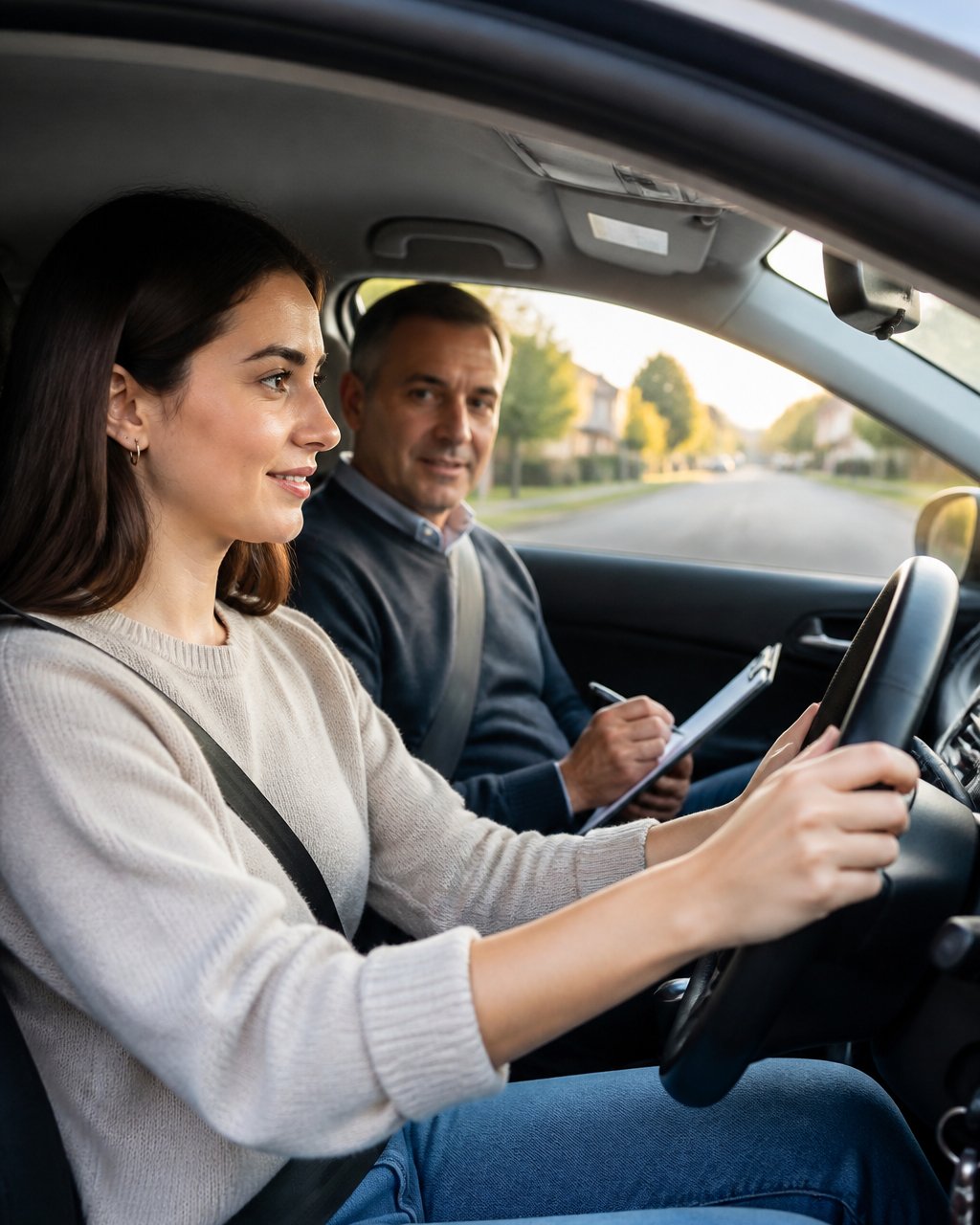
The four rules that make exposure work
- One new challenge at a time. Change either the road type, the traffic level or the time of day, never all three in the same session.
- Repeat until boring. A step is complete when your anxiety rating is 3/10 or lower for two consecutive sessions, not when you merely survive it once.
- Short and frequent beats long and rare. Three 20-minute drives a week will move you faster than one 90-minute ordeal.
- Never move up on a bad day. If a session ends in panic, repeat the same step next time. Dropping back is part of the method, not a failure.
A measurable plan you can follow
Rate your anxiety out of 10 at the end of every drive. Use the same rating each time so the numbers are comparable.
| Step | Where | Goal | Practice frequency | Move on when... |
|---|---|---|---|---|
| 1 | Empty car park | Start, stop, steer, park | 2 x 15 min | Anxiety 3/10 or lower for 10 minutes |
| 2 | Quiet back streets | Basic turns, low speed, give way | 3 x 20 min | Two calm sessions in a row |
| 3 | Suburban roads | Traffic lights, roundabouts, lane position | 3 x 25 min | You handle a full trip calmly |
| 4 | Busier roads | Lane changes, merging, following distance | 2-3 x 30 min | Anxiety stays at 5/10 or lower |
| 5 | High-traffic conditions | Peak-hour practice, unfamiliar routes | 2 x 30 min | You finish without dread |
The rule is simple: only move up when the current step feels boring. Boring means your brain has accepted it.
Tailor the plan to your specific trigger
Most nervous drivers are not anxious about "driving" in general, they are anxious about one or two situations. Build the ladder around yours.
- Highways and merging: start with a short on-ramp at a quiet time, merge into the left lane only, and exit at the next junction. Repeat until the merge feels routine before extending the distance.
- Bridges and tunnels: drive to the entrance and stop before it on the first session. Cross on the second. Repeat the crossing at a quieter time of day before attempting it in traffic.
- Heavy traffic and intersections: practise at off-peak times first, then add one busy intersection per session. Use a route you already know so the traffic is the only new variable.
Building a practice route from quiet streets to busier roads
Pick a loop near home that you can repeat without thinking about directions. Drive it until it is familiar, then extend it by one block, one intersection, or one short stretch of busier road per week. Keep a written log of the route, the time of day, your anxiety rating and one thing that went well. Over a few weeks the log will show progress that your feelings on any single day will not.
What to Do During a Panic Episode Behind the Wheel
If panic hits behind the wheel, your first job is to get safe, not to push through. A panic episode narrows your attention, speeds your heart rate and can make your hands shake, none of which belong at the controls of a moving car. The correct response is to reduce the demands on you immediately, then recover, then decide whether to continue.
Step 1: Get off the road safely
- Signal early and check your mirrors before you slow.
- Pull over as soon as it is legal and safe to do so, a side street, a car park, a lay-by. Do not stop on a clearway, in a bus lane, on a motorway shoulder unless it is an emergency, or anywhere your car would be a hazard.
- Put the car in park, apply the handbrake and turn on your hazard lights if you are stopped near traffic.
If you cannot pull over immediately, slow down, increase your following distance and take the next safe exit or turn. Do not attempt to manage a full panic attack while continuing at speed.
Step 2: Ground yourself
- Do your breathing technique until your heart rate drops, box breathing or a slow count of four in, four out.
- Name five things you can see and hear, then four you can touch. This pulls your attention out of the spiral and back to the present.
- Remind yourself: "This is a stress response, not danger. It will pass." A panic episode typically peaks and subsides within minutes, even though it feels longer.
- Unclench your hands, drop your shoulders and loosen your grip on the wheel.
Step 3: Decide whether to continue
Resume only when you feel steady, even if that takes ten minutes. Use a simple rule: if your anxiety is still above 6/10, or your hands are still shaking, end the drive safely and go home by the same route you came.
If you do continue, take the easiest route available, keep your speed down and give yourself extra following distance. Cancel any optional leg of the trip.
What not to do
- Do not force yourself to keep driving through a full panic attack. That teaches your brain the car is dangerous.
- Do not pull over in an unsafe spot just to stop moving. A few extra seconds to find a safe place is worth it.
- Do not treat the episode as evidence that you cannot drive. Treat it as information about which step of your exposure plan needs more repetition.
Driving lessons for nervous drivers: What Good Instruction Looks Like
Good driving lessons for nervous drivers are calm, structured and adapted to you. The instructor sets the pace, explains the why, and never raises their voice.
Look for an instructor who:
- Stays patient when you make a mistake.
- Breaks skills into small, clear steps.
- Adapts lessons for different triggers and learning styles.
This matters most for anxious and neurodivergent learners, who need things explained in a specific, predictable way.
At Precision School of Driving, our instructors specialise in nervous drivers and adapt each lesson to the person.
Tracking Progress, Handling Setbacks and Knowing When to Seek Professional Help
Track your progress with a simple log: route, anxiety out of 10, and what went well. Over weeks, the numbers tell the truth your feelings won't.
Setbacks are normal. A bad drive after ten good ones does not erase your progress. Drop back one step, rebuild, and move forward again.
Seek professional support if anxiety stops you driving entirely, causes panic attacks, or doesn't improve after consistent practice. For official guidance on road rules and licensing, check the state driver licensing authority in your area, and for mental health support, healthdirect's mental health resources.
Frequently Asked Questions
Can driving anxiety be overcome?
Yes. Driving anxiety responds well to gradual exposure, calming techniques and patient instruction. The key is progressing in small steps, starting on quiet streets and building up to busier roads only when each stage feels manageable. Most nervous drivers see real change within weeks of consistent, low-pressure practice. For some people, combining practice with professional support such as talk therapy speeds things up. Progress is rarely a straight line, so expect good days and harder ones and keep going.
What should I do if I have a panic attack while driving?
Signal early and pull over somewhere safe, such as a quiet side street or car park, then put the car in park and switch off the engine. Slow your breathing by counting a four-second inhale and a six-second exhale. Name five things you can see to ground yourself. Panic peaks and passes, usually within minutes. Only resume driving once your body has settled, and if you feel shaky, take a longer break or end the session. Repeated panic episodes are worth discussing with a GP.
How long does it take to overcome driving anxiety?
There is no fixed timeline. Some learners feel noticeably calmer after a handful of structured practice sessions, while others need months of gradual exposure, especially after a long break from driving or a frightening experience on the road. What matters more than speed is consistency: short, regular practice beats occasional long drives. Progress tracking helps you see gains that feel invisible day to day. If anxiety is not shifting after several months of practice, professional support can help.
Can driving lessons help with driving anxiety?
Structured driving lessons for nervous drivers can help significantly, provided the instructor is patient and adapts to your pace. A good instructor breaks skills into small steps, uses calm language, and never rushes a learner into traffic before they are ready. Lessons also give you a safe environment to practise feared situations with feedback. Ask upfront how a school supports anxious learners and whether instructors have experience with neurodivergent students before you book.
Driving anxiety is common, treatable, and not something you have to white-knuckle your way through alone. The right plan, the right pace and the right instructor make the difference. If you're ready to build real confidence behind the wheel, Precision School of Driving offers calm, patient lessons tailored to nervous drivers, with flexible scheduling and a safety-first approach. Book now and take the first small step.