 blog
Personalised Driving Lessons for Teens Build Real Confidence
Last Updated: November 17, 2026
Quick Summary
Personalised driving lessons for teens are built around each learner's confidence, skill gaps and learning style instead of a fixed syllabus at a fixed pace. The instructor assesses what the student can already do, identifies specific weak points, and builds the next lesson around them, so fewer hours are wasted.
- Standard lesson blocks cover the same manoeuvres in the same order whether the learner needs the repetition or not.
- Before the first lesson, the learner should hold a valid learner licence, wear flat-soled shoes and read the road rules handbook.
- There is no fixed number of driving lessons that guarantees test readiness; supervised practice between lessons is the real variable.
- Book a professional lesson roughly every one to two weeks and fill the gap with shorter supervised drives.
- Nervous and neurodivergent learners benefit from a consistent instructor, advance warning of the plan and single-step instructions.
Table of Contents
- Why Personalised Driving Lessons for Teens Beat One-Size-Fits-All Programs
- First Driving Lesson for Teens: What to Expect and How to Prepare
- How Many Driving Lessons Do Learners Need Before a Test?
- Parent Supervised Driving Practice Tips That Actually Work
- Teen Driving Lesson Checklist: Choosing the Right Provider
- Supporting Nervous and Neurodivergent Learners Behind the Wheel
- Book a Calm, Patient First Lesson With Precision School of Driving
- Frequently Asked Questions
Why Personalised Driving Lessons for Teens Beat One-Size-Fits-All Programs
Personalised driving lessons for teens are structured around the individual learner's confidence, skill gaps and learning style rather than a fixed syllabus delivered at a fixed pace. Lesson plans are built around what the student in the passenger seat actually needs next.
That distinction matters more than most families realise. Two teens can both hold a learner licence, both log the same hours, and still sit at completely different points: one freezes at roundabouts, the other panics on highway merges.
The difference between tailored instruction and standard lesson blocks
Standard lesson blocks run to a script. Every student covers the same manoeuvres in the same order, whether they need the repetition or not. It is predictable, and for a naturally confident learner it is often fine.
Tailored instruction works differently. The instructor assesses what the learner can already do, identifies the specific weak points, and builds the next lesson around them. A teen who struggles with reverse parking gets more time there.
The practical effect is fewer wasted hours and less frustration. You are paying for instruction, not for sitting in a queue behind a syllabus.
First Driving Lesson for Teens: What to Expect and How to Prepare
The first driving lesson for teens is generally a low-speed introduction to the vehicle, the controls and basic moving off.
Preparation helps the first hour go smoothly. Before the lesson, the learner should:
- Hold a valid learner licence and carry it
- Wear comfortable, flat-soled shoes
- Read the road rules handbook for their state or territory
- Know how to adjust the seat, mirrors and steering wheel
- Arrive having eaten and rested
A common mistake is booking a first lesson without reading the road rules first. The learner spends the hour absorbing basic terminology instead of driving. Fifteen minutes of reading beforehand buys back real practice time.
We walk every new student through a calm, structured first session. If you want the full step-by-step, read our guide on how to prepare for your first driving lesson in Adelaide.
How Many Driving Lessons Do Learners Need Before a Test?
There is no fixed number of driving lessons that guarantees test readiness. The real variable is how much supervised practice happens between lessons, and what the learner's state or territory requires before they can sit the test at all.
The reason lesson counts vary so widely is simple. Lessons teach technique; practice builds fluency. A learner who only drives during paid lessons will need more of them. A learner who practises weekly with a parent or supervisor consolidates each lesson far faster.
The licensing rules that shape lesson counts
Before you plan a lesson budget, check the supervised-driving hour requirement set by your state or territory licensing authority, because it changes how many paid lessons make sense. These requirements differ between jurisdictions and change from time to time, so confirm the current figures with your local authority before booking. Professional lessons work best as concentrated instruction layered on top of supervised practice.
A readiness framework, not a lesson count
Readiness comes down to specific competencies, not a number. Use this checklist to judge whether the learner is close to test standard:
- Can the learner complete a three-point turn without prompting?
- Do they check mirrors and blind spots consistently, or only when reminded?
- Can they hold a safe following distance in traffic?
- Do they stay calm when something unexpected happens?
- Can they merge, change lanes and enter a roundabout without step-by-step instruction?
- Do they scan ahead and anticipate hazards, or react late?
- Can they reverse park and parallel park to a test standard?
When those answers are consistently yes across varied conditions, not just on a quiet suburban loop, the learner is close to test readiness. Track competencies, not just hours. A simple progress sheet, updated after each lesson and each supervised drive, can show progress more clearly than a logbook total alone.
How to split paid lessons and supervised practice
A common pattern is to book a professional lesson roughly every one to two weeks and fill the gap with shorter supervised drives, which helps skills stay fresh between lessons.
Booking a block of lessons back-to-back with no practice in between can waste money, as learners may forget material between sessions.
Parent Supervised Driving Practice Tips That Actually Work
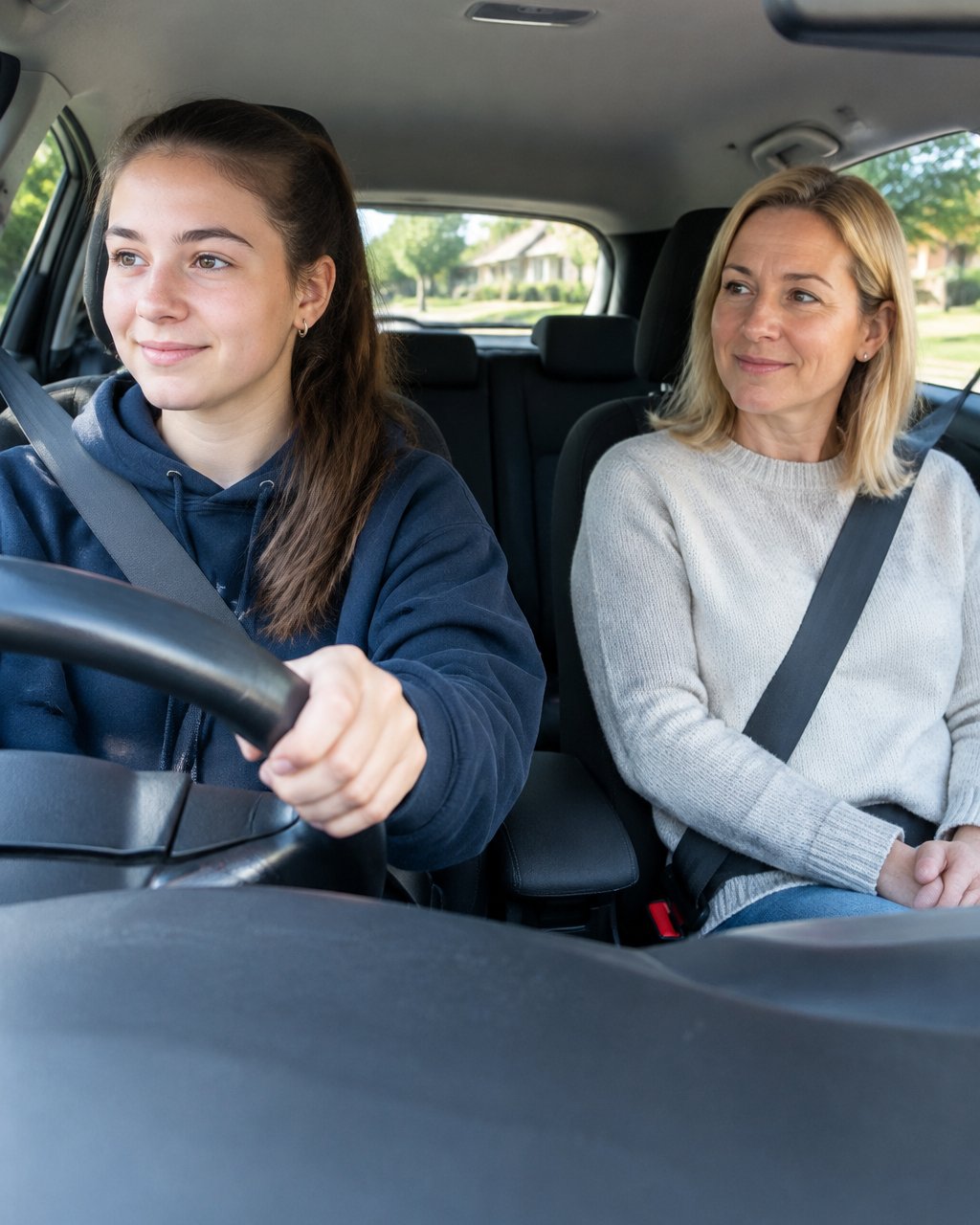
Supervised driving tends to work best when the parent acts as a calm co-pilot rather than a second instructor.
Practical tips that hold up:
- Agree the route before you leave. Pick one skill to focus on per session, not five.
- Give directions early. "Turn left at the next street" beats a last-second "turn here."
- Stay quiet during tricky manoeuvres. Comment afterwards, not mid-park.
- Log hours straight away. Logbook hours get forgotten and reconstructed badly.
- Practise in varied conditions. Quiet streets first, then traffic, then dusk and light rain.
Watch out: supervising a learner when you are tired or rushed is the fastest way to turn practice into an argument. Short, focused sessions beat long, tense ones every time.
Teen Driving Lesson Checklist: Choosing the Right Provider
Before you book, compare providers on substance rather than advertising. Our practical guide to what to look for in driving schools gives you a checklist to work through. A practical checklist for parents cuts through the sales pitch quickly, and the questions below go further than most school websites will take you.
- Is the instructor fully qualified and licensed to instruct learners in your state or territory?
- Does the school offer a structured, tailored training plan per student, or a fixed syllabus?
- Are lessons available outside standard business hours, including weekends?
- Are the vehicles registered, insured and fitted with dual controls?
- Can the school explain its approach to nervous or anxious learners?
- Is there a clear progress record the parent can see between lessons?
- Does the instructor explain things calmly, or rush the learner?
- What is the lesson package structure and hourly lesson rate?
- Does the school offer a logbook or progress sheet aligned to your state's licensing requirements?
- Can you speak to the instructor before booking, and request the same instructor for every lesson?
Questions to ask before you book
Ask directly: "How do you adapt lessons for a learner who is anxious?" and "How do you track progress between lessons?" The answers tell you more than any website. Two more worth asking: "How do you coordinate with what parents are practising at home?" and "What does a learner need to demonstrate before you'd say they're test-ready?" A school that can answer those in specifics is usually the one worth booking.
Matching the provider to the learner
Personalisation is the whole point of this article, so match the provider to the teen rather than to the cheapest hourly rate. A few common patterns:
| Learner profile | Provider fit | What to confirm |
|---|---|---|
| Confident, test-focused | Large franchise or independent instructor with test-route experience | Availability and test-day booking support |
| Anxious or easily overwhelmed | Specialist nervous-driver instructor | Instructor experience with anxiety, and a consistent instructor |
| Neurodivergent learner | Instructor with adapted-instruction experience | Written lesson plans and single-step instruction |
| Tight budget, strong parent support | Independent instructor plus structured parent practice | Progress tracking so paid hours aren't wasted |
| Learner in a 120-hour state | Any qualified school plus a practice plan | Logbook alignment and a realistic lesson cadence |
What lessons actually cost, and what else to budget for
Lesson pricing varies, so for current prices and package options please visit our website or request a quote. Beyond the lesson rate, budget for:
- Learner licence and test fees charged by your state licensing authority.
- Extra lessons if the learner needs more time than a package covers.
Add those up before comparing packages, and ask each provider for a total estimate covering everything involved.
Getting parents into the plan
Supervised practice is where most of the hours are logged, so choose a provider that treats parents as part of the program. It can help to ask whether the instructor will suggest a short practice focus after each lesson, so the parent reinforces the same skill at home.
Booking the cheapest package without confirming who the instructor will be can mean a different instructor each lesson, which can work against consistency.
Supporting Nervous and Neurodivergent Learners Behind the Wheel
Nervous drivers need predictability before they need speed. The same applies to neurodivergent learners, who often benefit from clear structure, written instructions and a lesson plan that does not change without warning.
What actually helps:
- Consistent instructor. Same person, same car, same expectations each week.
- Advance warning of the plan. Knowing what today's lesson covers lowers anxiety.
- Instructions broken into single steps. One instruction at a time, not three.
- Permission to pull over. A learner who knows they can stop feels safer continuing.
A common mistake is pushing a nervous learner into traffic too early to "build toughness." It backfires. Confidence compounds when each session ends in success. Our guide on driving lessons for nervous drivers covers confidence-building in more depth, and for learners who need a genuinely adapted approach, our steps to find a driving instructor for neurodivergent learners walk through it.
Book a Calm, Patient First Lesson With Precision School of Driving
Precision School of Driving offers personalised driving lessons with calm, patient instruction designed to help learners build confidence.
Our instructors specialise in nervous and anxious drivers, offer flexible scheduling around school and work, and keep our vehicles safe and regularly maintained. If you want a deeper look at how tailored lessons work, read our customised driving lessons for beginners guide.
Most learner drivers do not fail because they lack hours behind the wheel. They struggle because nobody adapted the teaching to how they actually learn. That is the problem worth solving first.
Frequently Asked Questions
What should I look for in personalised driving lessons for a teenager?
Look for a qualified instructor who adapts the plan to your teen's experience and confidence level, not a fixed lesson block. Ask how they handle nervous learners, whether they offer flexible scheduling, and what vehicles they use. A good provider explains progress in plain terms and gives parents clear feedback after each session. Check that lessons cover road safety, on-road experience and test preparation, not just parking practice.
How many driving lessons does a teen learner need?
There is no fixed number. It depends on prior practice, confidence and how quickly your teen builds skills. Learners who do regular supervised driving between lessons often need fewer professional sessions. It can help to ask the provider about progress reviews before committing to a large package upfront. Readiness for the driving test should be based on demonstrated skills, not hours logged.
Can driving lessons be tailored to a nervous teen?
Yes. A patient instructor can start on quiet streets and build up to busier roads as the learner becomes ready. Tell the school about your teen's anxiety when booking. Calm, structured instruction with clear explanations helps nervous drivers progress without feeling overwhelmed.
How can parents support a teen learning to drive?
Stay calm in the passenger seat, practise in low-traffic areas first and keep sessions short and regular. Follow the instructor's guidance on what to practise between lessons so you reinforce the same habits. Use a logbook to track hours and skills, and avoid correcting your teen mid-manoeuvre. Consistency between professional lessons and home practice makes the biggest difference.