 blog
After-Hours Driving Lessons in Adelaide Hills: A Guide
Table of Contents
- What Are After-Hours Driving Lessons?
- Evening Driving Lessons in the Adelaide Hills
- Weekend Driving Lessons in the Adelaide Hills
- Driving Lesson Prices and What to Expect
- After-Hours Lessons for Nervous Drivers
- How to Choose the Right Lesson Time for Real-World Practice
- Booking Your After-Hours Lesson
- Frequently Asked Questions
Last Updated: October 9, 2026
What Are After-Hours Driving Lessons?
After-hours driving lessons are instruction sessions scheduled outside standard business hours, typically in the evening or on weekends.
Many learner drivers benefit from evening and weekend instruction because it fits their school or work commitments. More importantly, practising when daylight fades teaches hazard perception under different lighting conditions. This mirrors the conditions they'll actually face as independent drivers.
At Precision School of Driving, we understand that flexible scheduling isn't just convenient, it's essential for building safe, confident drivers.
Evening Driving Lessons in the Adelaide Hills
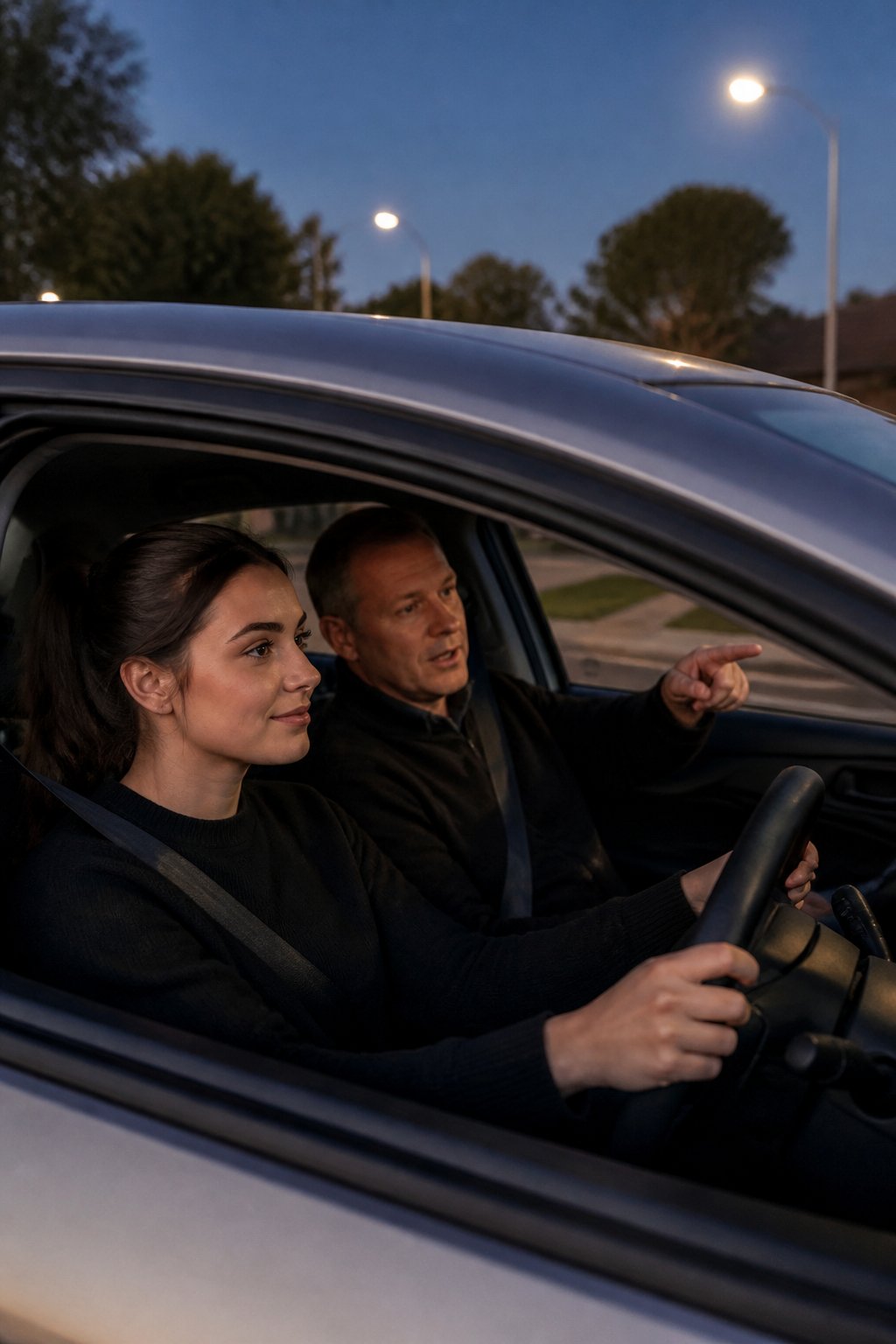
Evening driving lessons typically run from late afternoon through dusk and into early evening. This timing captures the transition from daylight to artificial lighting, which is where many new drivers struggle most.
Practising during evening hours means your learner encounters:
- Reduced traffic volumes compared to peak hours
- Changing light conditions that test hazard perception
- Different road behaviour patterns from daytime driving
- More relaxed pressure to rush through lessons
The Adelaide Hills region benefits from quieter roads during evening hours, making it an ideal location for building foundational skills before progressing to busier conditions.
When booking evening driving lessons, consider that winter evenings arrive earlier, so lesson timing shifts seasonally. A 5 PM lesson in June differs significantly from a 5 PM lesson in December in terms of available daylight.
Weekend Driving Lessons in the Adelaide Hills
Weekend lessons provide consistent scheduling without competing against school or work commitments. Saturday and Sunday sessions allow learners to dedicate full mental energy to instruction rather than juggling multiple demands in a single day.
Weekend driving offers distinct advantages:
- Reduced school-zone traffic and associated restrictions
- More predictable road conditions than weekdays
- Opportunity for longer lesson durations without time pressure
- Chance to practise varied scenarios across different times of day
Many learners progress faster with weekend instruction because they arrive less fatigued. A Saturday morning lesson differs from a Friday evening session, the learner's mental state, road conditions, and traffic patterns all shift.
The eastern suburbs and surrounding Adelaide Hills areas see moderate weekend traffic, making them suitable for intermediate and advanced learner practice.
Driving Lesson Prices and What to Expect
Most learner drivers want a straight answer on cost before they book. In the Adelaide Hills, after-hours lessons are usually priced per hour, with a small number of providers charging a modest out-of-hours loading for sessions that start after roughly 6 PM or on Sundays. The honest position is that rates vary by instructor, vehicle and travel distance, so the useful thing to publish is the structure, not a single number that goes stale.
How after-hours pricing is normally structured
- Single lesson (typically 60 minutes): the standard hourly rate, sometimes with a $5-$15 loading for late-evening or Sunday slots.
- Extended lesson (90-120 minutes): usually charged at the hourly rate with a small discount, because the instructor's travel and setup time is spread across more instruction.
- Prepaid packages (5 or 10 lessons): the most common way to reduce the effective hourly rate. A 10-lesson package is often 5-10% cheaper per hour than booking singles.
- Test-day packages: a lesson plus use of the instructor's vehicle for the practical driving assessment, priced separately from ordinary lessons.
- Travel surcharge: applies when the pickup address sits outside the instructor's normal service radius. This is the single biggest variable in the Hills, because a pickup in Stirling is a very different drive from one in Birdwood.
What actually drives the price up or down
Three things move the number more than anything else:
- Distance from the instructor's base. Instructors based around Mount Barker, Stirling or Nairne can cover nearby towns cheaply. A booking that requires 30-40 minutes of driving just to reach the pickup point will usually attract a surcharge or a minimum lesson length.
- Time of day. Early evening (4-6 PM) is often charged at the standard rate because it overlaps the tail of the business day. Genuine night lessons (after about 7 PM) and Sunday sessions are the ones most likely to carry a loading.
- Vehicle and transmission. Automatic lessons are the default. Manual instruction is less commonly available after hours because fewer instructors keep a manual vehicle, and it is often priced at a premium when it is offered.
Questions worth asking before you pay
- Is the quoted rate per hour or per lesson, and how long is a 'lesson'?
- Does the rate change after 6 PM, on weekends, or on public holidays?
- Is there a travel surcharge for my suburb, and is it a flat fee or per kilometre?
- What is the cancellation window, and is there a fee if I cancel inside it?
- If I buy a package, does it expire, and is it refundable if I move or stop lessons?
- Does the price include use of the instructor's car for the practical test, or is that a separate booking?
Why we don't publish a single flat rate
Adelaide Hills pickups span a large area, and a fair price for a lesson in Mount Barker is not the same as a fair price for a lesson that starts in Lobethal or Meadows. Rather than advertise a rate that only applies to a handful of suburbs, we quote based on your pickup location, your preferred time slot and whether you want a single lesson or a package. That way the number you see is the number you pay, with no surprise travel fee added later.
Current learner licence and logbook requirements
After-Hours Lessons for Nervous Drivers
Nervous or anxious drivers often benefit most from after-hours instruction.

A common mistake is pushing anxious learners into peak-hour traffic too quickly. This approach rarely builds genuine confidence, it often reinforces anxiety.
Precision School of Driving specialises in supporting anxious and neurodivergent drivers. Our instructors understand that patience and clear communication matter more than speed through the curriculum.
What most guides miss is that confidence comes from repeated success in manageable conditions, not from white-knuckling through stressful traffic.
How to Choose the Right Lesson Time for Real-World Practice
Most guides tell you to 'practise in varied conditions' and stop there. The useful version is to understand what each time of day actually trains, and then sequence them deliberately rather than randomly.
What each time slot is genuinely good for
- Mid-morning (roughly 9:30-11:30 AM): the quietest window on most Hills roads once school drop-off has cleared. Best for a first lesson, for building clutch and steering control, and for nervous drivers who need low cognitive load.
- Early afternoon (1-3 PM): light traffic, full daylight, school zones active during term. Good for practising speed management, school-zone rules and pedestrian awareness.
- Peak afternoon (3:30-5:30 PM): the hardest conditions in the region. School buses, parents collecting children, commuters leaving the city. Excellent for advanced learners preparing for the practical test, but a poor choice for a beginner's first few lessons.
- Dusk (roughly the 45 minutes either side of sunset): the single most underrated slot. Visibility is falling, headlights are coming on, and hazard perception is genuinely tested. This is where most learners discover they have been relying on being able to see clearly.
- Full darkness (after about 7 PM in summer, earlier in winter): trains headlight use, high-beam discipline on unlit Hills roads, and reading road edges and wildlife risk. Quieter traffic, but lower visibility.
- Weekend mornings: predictable, low-stress, and the best slot for longer 90-120 minute lessons because there is no time pressure from school or work.
Match the slot to the road, not just the clock
The Adelaide Hills is not one driving environment. Different roads teach different things:
- Mount Barker and Nairne: suburban grid streets, roundabouts, and the busier South Eastern Freeway interchange area. Good for general traffic skills at any time of day.
- Stirling, Aldgate and Crafers: winding, tree-lined roads with tight corners and variable speed limits. Best practised in daylight first, then revisited at dusk.
- Hahndorf and the Onkaparinga Valley road corridor: tourist traffic, narrow main street, pedestrians. Weekend afternoons here are busy; weekday mornings are calmer.
- Gumeracha, Birdwood and Lobethal: rural roads with unsealed edges, wildlife risk at dawn and dusk, and long stretches without street lighting. These are the roads where night lessons genuinely earn their place.
A practical sequencing plan
A common pattern that works well:
- First 3-4 lessons: mid-morning or early afternoon, quiet suburban streets. Focus on vehicle control.
- Next 3-4 lessons: introduce early evening and one weekend morning. Add busier intersections and roundabouts.
- Next 3-4 lessons: add dusk and one peak-afternoon session. Introduce hill starts, narrow roads and merging.
- Final 2-3 lessons before the test: at least one full-darkness lesson and one session at the same time of day as your booked practical test.
The trade-off most learners miss
Quiet roads feel easier, but they also hide weaknesses. A learner who only ever drives at 10 AM on a Tuesday may pass the test and then struggle the first time they drive home from work in the dark on a wet Hills road. The goal is not the easiest lesson, it is the lesson that trains the conditions you will actually drive in. Mixing daylight, dusk, darkness, peak and quiet periods across your logbook hours produces a driver who adapts rather than one who has memorised a route.
Booking Your After-Hours Lesson
Booking an after-hours driving lesson requires checking availability, confirming your preferred time, and understanding the provider's policies around rescheduling and cancellations.
Most driving schools now offer online booking systems alongside phone and email options. When you contact a provider, have these details ready:
- Your learner driver's licence number and current logbook status
- Preferred lesson times and days (specific times help, not just "evenings")
- Whether you need pickup and drop-off service
- Any specific learning goals or concerns your instructor should know about
- Your preferred vehicle type if the provider offers options
Booking in advance, ideally several weeks ahead, ensures you get your preferred time slots, especially for popular evening and weekend periods.
Ask about the provider's cancellation and rescheduling policy before booking. Life happens, and understanding whether you can reschedule without penalty matters.
Precision School of Driving makes booking straightforward.
Finding the right after-hours driving lessons in the Adelaide Hills means balancing your schedule with effective learning conditions.
Frequently Asked Questions
What counts as an after-hours driving lesson?
After-hours driving lessons typically occur outside standard business hours, usually from late afternoon through evening, or on weekends. These sessions allow learner drivers to practise during quieter traffic periods or when their schedules permit. Evening lessons often start around 4 or 5 p.m. and run into dusk or darkness, providing valuable experience in low-light conditions. Weekend lessons offer flexibility for those juggling school or work commitments. The exact definition depends on each driving school's operating schedule.
Are evening driving lessons suitable for nervous drivers?
Evening lessons can actually benefit nervous drivers. Lighter traffic volumes during off-peak hours mean fewer distractions and less pressure, helping anxious learners build confidence in a calmer environment. However, darkness and reduced visibility present their own challenges. A patient, supportive instructor experienced in working with nervous drivers can frame evening practice as an opportunity to develop hazard perception and vehicle control skills gradually. Discuss your anxiety with your instructor beforehand so they can tailor the lesson to your comfort level.
Do after-hours driving lessons cost more than daytime lessons?
Pricing for after-hours driving lessons varies between providers and depends on factors such as instructor availability, demand, and your location within the Adelaide Hills. Rather than assume a premium, contact your chosen driving school directly to ask about their current rates for after-hours sessions. Many offer flexible package options that can help manage costs across multiple lessons.
Can learner drivers practise at night in South Australia?
Learner drivers in South Australia can practise at night, but there are conditions. Your supervising driver (usually a fully licensed adult aged 21 or over) must be seated beside you, and you must display L-plates. Night driving provides essential experience in reduced visibility and different road conditions, which builds real-world confidence. However, many learners benefit from starting evening practice during twilight hours before progressing to full darkness. Your instructor can advise on when you're ready for night-time driving and help you develop the skills needed.