 How-to
Driving lessons for anxious adults: a calm guide
Table of Contents
- Why driving anxiety affects adults and nervous learners
- Practical driving anxiety tips to manage nerves
- How to overcome fear of driving with structured practice
- Choosing a patient, supportive driving instructor
- Refresher driving lessons for adults returning to the road
- Driving lessons after a long break: what to expect
- Building confidence through gradual practice and manageable steps
- Frequently Asked Questions
Last Updated: October 18, 2026
Why driving anxiety affects adults and nervous learners
Driving anxiety isn't a character flaw, and driving lessons for anxious adults address this reality directly.
Adults have more life experience, so the stakes feel higher because they are. That awareness creates a feedback loop: anxiety triggers physical responses (tight chest, shaky hands, tunnel vision), which make driving harder, confirming the fear.
Nervous learners struggle with the gap between instruction and reality: a calm car park is nothing like a busy intersection, and the jump to unpredictable traffic can trigger panic.
This is where driving lessons for anxious adults differ from standard instruction. Most driving schools teach technique. They don't teach how to manage the emotional experience of learning to drive when your nervous system is working against you.
Practical driving anxiety tips to manage nerves
Anxiety management starts before you sit in the driver's seat, but what matters most is what you do when nerves spike mid-lesson. A practical plan needs both preparation and a safety-first response.
Before the lesson
Breathing techniques work because they interrupt the panic cycle: anxiety makes breathing shallow and fast, which your body reads as danger, while slow breathing signals safety.
Try this before a lesson:
- Breathe in for a count of 4
- Hold for a count of 4
- Exhale for a count of 6
- Repeat 5 times
The longer exhale is key. It activates your parasympathetic nervous system, which calms you down.
Prepare mentally. Spend 10 minutes the night before visualising yourself calmly checking mirrors, turning smoothly and stopping safely. Your brain treats mental rehearsal as practice, which reduces anxiety.
Limit caffeine on lesson days. Caffeine amplifies anxiety symptoms, making your heart race and your thoughts scatter.
Listen to calming music on the drive to your lesson.
Eat something light. Hunger and anxiety feel similar: shaky, unfocused, irritable. A banana or handful of nuts 30 minutes before your lesson steadies your blood sugar and nerves.
During the lesson: a safety-first response plan for acute anxiety
This is the part most guides leave out. If anxiety escalates behind the wheel, you need a sequence you can follow without thinking.
1. Tell your instructor immediately. Use a simple phrase you've agreed on, such as "I need to pull over." A good instructor will not treat this as failure.
2. Pull over safely. Signal, check mirrors and blind spots, and stop in a legal, safe place: a quiet side street, car park or designated stopping bay.
**3.
4. Use a grounding sequence. Name five things you can see, four you can hear, three you can touch.
5. Resume only when your body settles. Wait for your heart rate to drop and your hands to stop shaking.
**6.
Know the signs that mean stop, not push through: chest pain or tightness, dizziness, blurred vision, numbness, or a feeling you may faint. Pull over as soon as it is safe and do not continue the lesson.
How to overcome fear of driving with structured practice
Fear fades through exposure, but only if the exposure is manageable.
Start in familiar territory. Your first lessons should be on roads you know well.
Build in small wins. Each lesson should end with a success: three smooth turns, a roundabout navigated without hesitation. Wins build confidence, and confidence erodes fear.
Progress gradually through manageable steps. Week one: quiet residential streets. Week two: slightly busier roads, maybe a main road at off-peak times. Week three: busier conditions, perhaps a short highway stretch.
This isn't slow. It's efficient. Rushing creates setbacks. Setbacks reinforce fear. Gradual progress feels slow but it sticks.
Practice consistently. Irregular lessons mean relearning what you forgot each session. Consistent practice (ideally twice weekly) keeps skills fresh, builds momentum, and helps your nervous system adapt faster.
Choosing a patient, supportive driving instructor
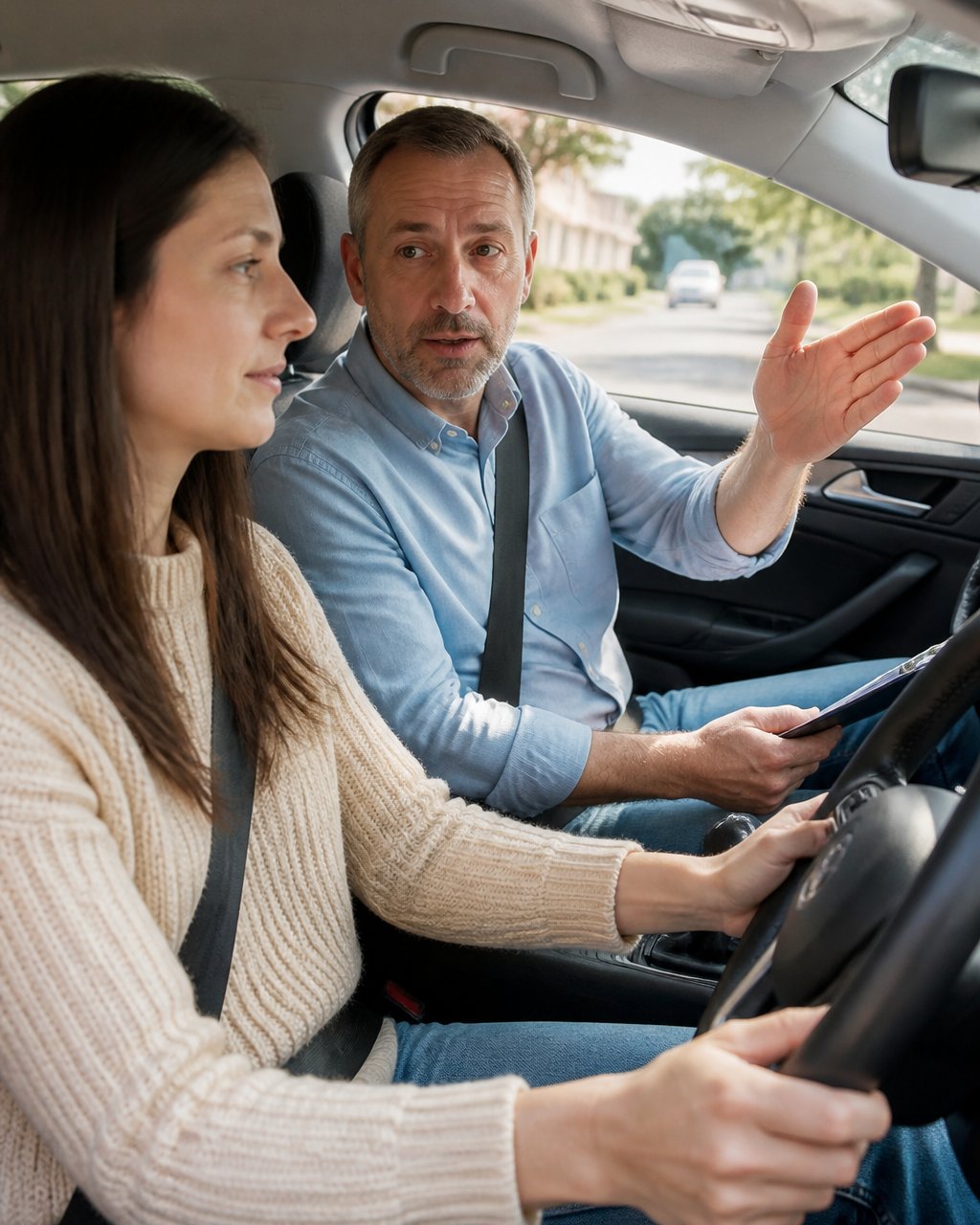
Your instructor shapes your entire learning experience: the wrong one can deepen anxiety, the right one can transform it. "Find someone patient" isn't enough to act on. You need a way to assess fit before you book, boundaries to set once you start, and clear signs to walk away.
A patient instructor doesn't get frustrated when you stall the engine or miss a turn.
Questions to ask before booking
Ask these on the phone or by email, not in the car on lesson one. The answers tell you more than any marketing copy.
- Have you worked with anxious or nervous adult learners before? Can you describe a typical progression?
- How do you respond when a student makes a mistake or needs to pull over?
- What is your approach for an adult learning for the first time, or returning after years away?
- Are you willing to repeat explanations without impatience?
- How do you structure a first lesson for someone who is anxious?
- What are your lesson lengths and rates, and is there a cancellation policy?
- Are you willing to agree on a "pull over" phrase and a safety-first plan before we start?
Listen to how they answer. Defensive responses are red flags; genuine experience shows in specifics. "I've helped dozens of anxious learners, and we usually start in a quiet car park and build up over several lessons" beats "I'm patient with everyone."
Boundaries to set once you start
A good instructor will welcome these. If they resist, that is information.
- Agree on a stop signal. A word or phrase that means "pull over safely now" with no debate.
- Agree on lesson length. Shorter lessons are fine. Ask for 45 minutes if 60 feels too long.
- Agree on route progression. Confirm that quiet roads come before busy ones, and that you will not be pushed onto a motorway before you are ready.
- Ask for a debrief. Two minutes at the end of each lesson on what went well and what to work on next.
- Keep a log. Note what you covered and how you felt. It helps you and your instructor adjust.
Warning signs to walk away
- They dismiss your anxiety or tell you to "just relax."
- They raise their voice, sigh, or grab the wheel without warning.
- They push you into traffic or a motorway before you have agreed to it.
- They won't discuss lesson structure, pricing, or a stop signal before you book.
- They make you feel rushed or embarrassed after a mistake.
You are allowed to change instructors. Switching is not a failure; it is part of finding the right fit. A short trial lesson is a low-risk way to test compatibility before committing to a block.
At Precision School of Driving, we specialise in supporting anxious or nervous drivers. Our instructors understand that anxiety isn't a weakness. It's a starting point. We tailor each lesson to your pace, not a standardised curriculum, and we agree on a stop signal and lesson plan before your first session. That flexibility matters for adults with real anxiety, not just normal nerves.
Refresher driving lessons for adults returning to the road
Adult learners fall into two categories: those learning for the first time, and those returning after years away. Refresher driving lessons for adults address a different challenge: reactivating dormant skills while managing anxiety about what's changed.
Roads, traffic and your confidence have all changed. That gap creates anxiety.
A good refresher programme doesn't treat you like a teenager learning for the first time. It recognises that you have foundational knowledge but need to rebuild confidence and update your knowledge of current road conditions and rules.
Refresher lessons should cover:
- Current road rules and changes since you last drove
- Modern vehicle controls and technology
- Updated hazard awareness for current traffic patterns
- Confidence-building on roads you'll actually use
The first refresher lesson isn't about pushing you onto a motorway. It's about assessing where your skills actually are and rebuilding from there.
Driving lessons after a long break: what to expect
Driving lessons after a long break follow a different arc than lessons for new learners. You'll progress faster in some areas and slower in others.
Expect to feel rusty initially. Muscle memory fades. The coordination between steering, braking, and gear changes feels unfamiliar. This passes quickly, usually within 3-4 lessons.
Expect your anxiety to spike early. The first lesson back is often the hardest. You've built up the fear in your mind for years. Reality is usually less scary than imagination.
Expect to relearn some rules. Road rules evolve. Speed limits change. New signs appear. New traffic technologies emerge.
Plan for 6-12 refresher lessons depending on how long you've been away and how much your local roads have changed.
Building confidence through gradual practice and manageable steps
Confidence builds through success, not through facing your worst fear immediately. This principle applies whether you're learning for the first time or returning to driving after a long break.
Map out a realistic progression:
| Stage | Focus | Typical Duration |
|---|---|---|
| Stage 1 | Vehicle controls, quiet streets | 4-6 lessons |
| Stage 2 | Busier residential roads, basic intersections | 4-6 lessons |
| Stage 3 | Main roads, moderate traffic | 4-8 lessons |
| Stage 4 | Complex traffic, motorway introduction | 4-6 lessons |
| Stage 5 | Independent driving, real-world scenarios | Ongoing practice |
This progression isn't rigid. Your instructor adjusts based on your actual progress, not a schedule.
Celebrate small milestones. You completed your first lesson without panic. That's a win. You navigated a roundabout smoothly. That's a win.
Practice between lessons. Lessons teach you what to do. Practice embeds it.
Track your progress visually. Write down what you achieved each lesson.
Precision School of Driving builds this progression into every adult programme. We don't rush. We adjust. We celebrate progress.
Returning to driving after years away, or learning to drive as an anxious adult, is genuinely hard. But it's achievable.
Frequently Asked Questions
How long does it take to overcome driving anxiety with proper instruction?
There's no fixed timeline, it depends on the severity of your anxiety and how frequently you practise. The key is consistent, low-pressure practice in a calm learning environment. Some people build confidence faster; others need more time. Working with an instructor experienced in anxiety-sensitive driving lessons helps you progress at your own pace rather than rushing.
What should I do if I feel overwhelmed or panicked while driving?
If panic rises during a lesson, signal to your instructor immediately. Safe responses include: pulling over to a quiet area, stopping the car, taking slow deep breaths (in for 4 counts, out for 4 counts), and pausing until you feel calmer. Your instructor should reassure you and help you regain focus without pressure. Never push through severe panic, stepping out of the car, taking a break, or rescheduling the lesson is always an option. A supportive instructor will treat this as normal and help you build coping strategies for future lessons.
How is a driving lesson for an anxious adult different from a standard lesson?
Anxiety-focused lessons prioritise your emotional comfort alongside skill development. Your instructor will start with quiet roads or familiar areas, explain vehicle controls clearly, allow time for questions, and progress at your pace, not a preset schedule. They'll use calming communication, avoid criticism, and help you practise relaxation techniques. The lesson structure is often more flexible, with shorter initial sessions if needed. The goal is building both driving competence and genuine confidence, not just ticking boxes.
Can I take driving lessons after a long break if I'm nervous?
Yes. Refresher driving lessons for adults are specifically designed for people returning to driving after months or years away. Your skills may be rusty, but muscle memory often returns faster than expected. A patient instructor will assess your current comfort level, start with basic vehicle familiarisation, and rebuild your confidence through manageable steps on quiet roads before progressing to busier traffic. Many adults successfully return to confident driving with structured refresher lessons tailored to anxious or nervous learners.